On Being an English Rose.
I'm not Oasis-British, I'm Nadiya Hussain-British.

When I was in Year 10, my physics teacher was trying to explain a theoretical concept using some kind of culturally relevant metaphor. This teacher was usually quite good at his pop-culture references, but when he missed the mark, he missed it hard.
One time, I believe he must have been trying to explain the idea of magnets attracting and repelling and had landed on a pair of ice skaters as his metaphor. Okay, sure.
The class went something like this:
“When your two magnets are the same, they push away from each other – think of Torvill and Dean, pushing away from each other on the ice.”
He was met with a lot of blank faces.
“Torvill and Dean?” he repeated.
…
Nothing.
I piped up, “You guys don’t know Torvill and Dean? Dancing On Ice? On ITV?”
The faces of the rest of my classmates at the West London girls’ school were still very blank.
I had the opportunity to do the funniest thing ever. So, naturally, I jumped.
“Wow…” a smug, fourteen-year-old SJ started, “you people have no culture.”
I fear that I will never have the wit that I had at that age ever again. That line alone should have been enough to get me on SNL.
As with all good jokes, let me explain it so that it’s even funnier. Torvill and Dean are an ice-skating duo, famous for representing Britain in the Olympics. For some reason, this was not common knowledge amongst my peers. I was the only fully Black (and painfully working class) girl in that class. This particular cohort consisted of something like twenty or so girls who were varying shades of alabaster, two or three racially ambiguous darlings, and myself. The fact that I even fixed my lips to tell these people that they lacked the cultural knowledge of their own people made me – and still makes me – extremely giddy.
The Torvill and Dean bit was a kind of osmotic knowledge. My best friend in primary school was a Scottish-English girl who loved ice skating – and so we would watch Dancing on Ice together on the weekend. But, other than that, British culture is my bag.
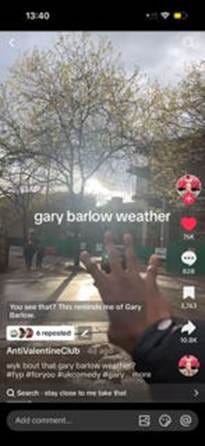
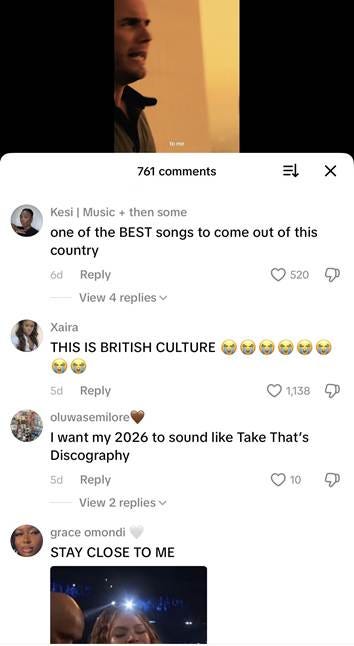
There’s been a recent resurgence of love on TikTok for the boyband Take That, led by Black Brits. As someone who grew up listening to the radio (namely Magic 105.4), Take That was a staple part of my playlists growing up. The band also means a lot to me because the first conversation I had with my now-closest friends was sat around a uni accommodation table talking about how Gary Barlow ‘had bars in his time’ and was ‘nice with the pen’. Stormzy never could have written ‘Greatest Day’, but Gary Barlow could have written ‘Blinded By Your Grace’ in his sleep. I think it’s worth noting that this group of girls consists mainly of second-generation immigrants – a mixture of Black and Brown; only one of us would pass a paper bag test.
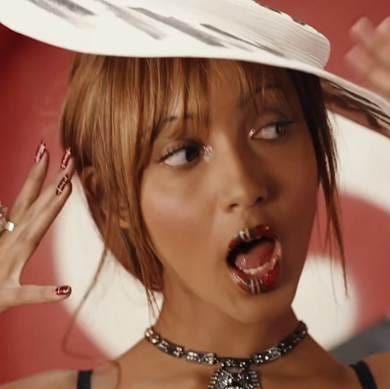
‘British’ has a new face in the 21st century. Jim Legxacy’s ‘Black British Music (2025)’ is a masterclass in showcasing what being British means to him; with his album a testament to the UK’s diverse underground scene. Jim is one of the most exciting artists out right now, giving a voice to what it feels like to have grown up with strikingly different influences. Similarly, PinkPantheress could not be more British if she tried – her new music video for the ‘Stateside’ remix is a Y2K fantasy that plays with the stereotypical ideas of Britishness. With both artists rightfully nominated for upcoming BRIT awards, they are exemplary of how foreign influence elevates the British identity, rather than subtracting from it.
Cultural curator and TikTok user @umnia_ constructs a binary of Britishness. You can be “Oasis-British”, or you can be “David Bowie-British”. “Kate Moss-British” or “Lenny Henry-British”. “KSI-British” or “Dan and Phil-British”, she puts in ‘digital terms’. The binary is not based on racial identity; she also asserts that she is both “Nigella Lawson-British” and “Nadiya Hussain-British”. The binary is constructed around those who are representative of tradition and antiquity (losers who are scared of change) and those who are breaking boundaries and are ushering in the new. “That Het’rogeneous Thing, An Englishman” writes Daniel Defoe in 1701, an English author defending the new Dutch-born King. Although I don’t know what he would make of the state of things today, that white royalist had a point. Britain has always been an island of diversity and has always been better for it.
Britain is my home, despite what a couple of xenophobic weirdos might have to say about it. I love British culture: I love talking about the weather! I love fish and chips! I love Homes Under the Hammer! I just also really love immigrants. So many of us love this country but it doesn’t always love us back. Growing white nationalist sentiment promotes the idea that people like me are not welcome here. That people not of Anglo-Saxon descent need to ‘go back to their countries’. So many of us have revelled in the fantasy of fleeing the country. Going to places where people look more like us in the pursuit of reclaiming ethnic identities. However, that comes with its own issues: how do I feel at home in a country that I don’t really know? The wish to make the land of my ancestors into something of my own home feels contradictory to the work that my mother put in to get me where I am today. And as much as Ghana might be the place to be in December, the people living there spend every other month plotting their escapes.

I propose to my fellow diasporic readers a new approach to your disillusionment – radically staying exactly where you are. I don’t care what anyone else has to say - I’m English. The same way that you’ll meet a guy called Damilola who swears up and down that he’s Irish, if anyone asks me where I’m really from, I’m telling them that I’m from England - Shepherd’s Bush to be exact. Certain people want ‘their’ country back? Too bad, they can’t have it - it’s under new management. We saw what you were doing with the place, and we weren’t impressed. Me and the rest of the Nadiya Hussain-Brits are reclaiming our country.